Instagram App Store Link Not Working: Still Broken in August 2026
Last updated
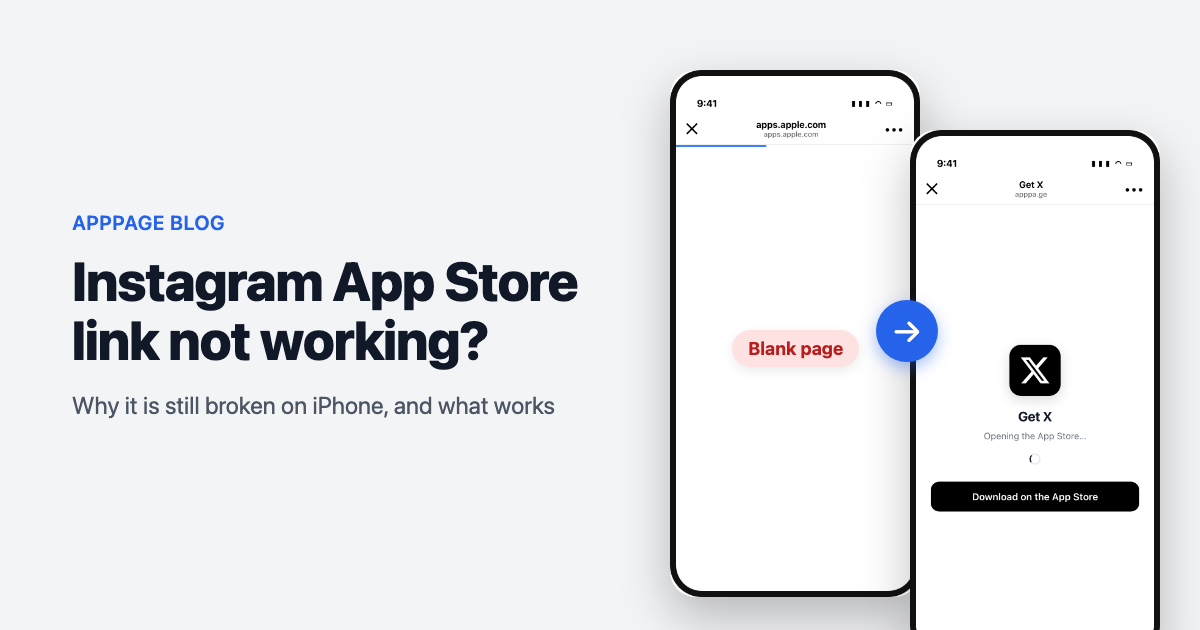
Checked again on 10 August 2026: it is still broken. Tap an App Store link from an Instagram bio on an iPhone and you get a blank page, a spinner, or nothing at all. Reports have been building for days now from people who watched a bio link that used to deliver installs quietly stop delivering them. Meta has announced nothing, fixed nothing, and given no indication it intends to.
If you landed here because a link that works everywhere else dies inside Instagram, this post covers three things: what is actually failing, why you should plan for it being permanent, and what to do about it this week.
Is the Instagram App Store link problem still happening in August 2026?
Yes. As of 10 August 2026, App Store links still fail to open from Instagram's in-app browser on iOS. Paste the link into Safari on the same iPhone and the App Store opens instantly. Tap the identical link from inside Instagram and the hand-off never happens, so the page sits there with nothing to show. It is not specific to your app, your account or your ad creative: it tracks the browser the tap happens in. For the mechanics of why the hand-off fails, see why Instagram blocks App Store links.
Why this is not a bug waiting to be fixed
Most people read this as an outage, and outages get fixed. It is more useful to read it as architecture. Three reasons.
1. The in-app browser is the point, not an accident
Instagram does not hand your link to Safari because the embedded browser is worth something to Meta. Its iOS apps are documented to inject JavaScript into the pages they load in that webview, which lets the app observe what happens on sites it does not own. A browser you control is an asset. Passing users to Safari gives that up.
2. Leaving the app is the behaviour the design discourages
Every hand-off to another app ends a session. The webview keeps a back button between your page and the feed. That is a retention decision rather than an oversight, and it applies to the App Store the same as it applies to everything else.
3. There is no bug report to close
From Meta's side, nothing failed. The page was requested, the page loaded, nothing crashed. The only place this shows up is in your install numbers, and Meta does not see those. A failure nobody logs is a failure nobody prioritises.
Regulatory pressure has not moved it either. The scrutiny aimed at Meta's webview, in the EU and elsewhere, has been about data collection inside it, not about whether it hands off to other apps. Even a Meta that stopped injecting scripts tomorrow would still open your link in its own browser.
Where this stands as of 10 August 2026
| Question | Where it stands today |
|---|---|
| Does it still fail? | Yes. Retested from an Instagram bio on a current iPhone on 10 August 2026. |
| Has Meta acknowledged it? | No statement, no changelog entry, no support article. |
| Is it only some accounts? | No. Not sampled, not regional, not tied to account age or verification. |
| Is a fix expected? | Nothing suggests one. The hand-off is not a feature Meta has reason to add. |
| Is there an official workaround? | None. Google also shut Firebase Dynamic Links down in August 2025, so the old no-cost redirect layer is gone too. |
The practical conclusion is not that Meta has declared war on your install funnel. It is quieter than that, and worse: there is no mechanism by which this gets better on its own. Build for it being permanent.
You are not imagining it
There is no status page for this, so the confirmation comes from other people running into the same wall. On 9 August 2026 someone posted in r/InstagramMarketing under the title App store links no longer working from instagram bio. Their description is the version of this most people arrive at on their own: an iOS app being marketed with UGC videos, plenty of views on the videos, no downloads at the other end, and eventually the realisation that it was not their link in particular but every App Store link.
We replied in that thread suggesting an apppa.ge link. The poster tried it and came back with "oh man it just worked, and really like how quick it is". One person, and we are obviously not a neutral party in that exchange, so treat it as illustration rather than proof. What it illustrates is worth the read regardless: nothing about the app changed, nothing about the campaign changed, only the link did.
Confirm it in thirty seconds
- Open your store link in Safari on an iPhone. The App Store should open immediately. That rules out the URL.
- Put the same link in your Instagram bio, or send it to yourself in a DM.
- Tap it from inside the Instagram app on that same iPhone.
If the App Store has not opened within about three seconds, you have reproduced it. Same URL, same device, two outcomes. Do not run this test on desktop, on Android, or by pasting the link into Safari, because all three of those paths work and will tell you everything is fine.
Why your dashboard shows no problem
The tap registers. Your link shortener counts it, your ad platform counts it, your landing page counts it. What never happens is the store impression at the other end, and nothing in your funnel is watching for that.
The quickest way to size the gap: compare clicks on your Instagram link against product page views from web referrers in App Store Connect over the same window. Traffic that leaves one number and never arrives in the other is traffic the hand-off ate.
What does not fix it
| Approach | Does it work from Instagram on iOS? | Why |
|---|---|---|
| Shortening the URL with Bitly or similar | No | The redirect resolves one hop later, in the same webview |
| Pointing straight at apps.apple.com | No | The webview drops the hand-off wherever the URL points |
| A link-in-bio page | No | It opens in the same browser, and so does everything on it |
| An attribution or MMP link | No | Before install it is an ordinary web link, and an SDK cannot change a browser it is not running in |
| Telling followers to open in Safari | Only if they do it | Four taps, asked of someone who has not yet decided they want your app |
| Firebase Dynamic Links | Not available | Shut down in August 2025, and it never handled the in-app browser case anyway |
What actually works
There is one requirement. The visitor has to leave the in-app browser before iOS is asked for the App Store, or be given a single deliberate tap that takes them out. Once the tap happens in a real browser, everything behaves the way it does in your own testing.
That is what a smart link does, and the routing matters as much as the escape:
- iOS in Safari or Chrome - straight redirect to the App Store, because nothing needs interrupting.
- iOS inside Instagram, Facebook, Messenger or Threads - a purpose-built page that escapes the webview and opens the store, with a one-tap fallback and a copyable link for anyone who prefers to do it by hand.
- Android - straight through to Google Play, which resolves from embedded browsers far more forgivingly.
- Desktop - your landing page, with a QR code, rather than a store link nobody can use.
One honest caveat, because the alternative is to sell you certainty that does not exist: no escape technique is permanent. Meta ships builds, and paths that work today can close. That is exactly why publishing a code snippet is the wrong answer, since a snippet goes stale without telling you. What you want is not a clever trick, it is somebody whose job it is to keep retesting the trick.
Fix it surface by surface
- Link in bio - the highest-volume version of this failure. Replace the store URL with your smart link.
- Story link stickers - same webview, same failure, and often the least tested surface you run.
- Instagram ads - change the destination URL. You are paying per tap for this one, so it is usually where the money is.
- DMs - links pasted into a chat open in the same browser. Support replies and creator outreach both hit it.
- Facebook, Messenger and Threads - one link covers all of them, because they share the browser.
- TikTok and LinkedIn - different apps, their own in-app browsers, similar limitations.
- QR codes and print - these were never affected, because the camera opens the real browser. Leave them alone.
How you will know it worked
Two numbers move. Those App Store Connect product page views should climb within a few days at unchanged ad spend, and your link analytics should start showing you what share of iOS taps arrive from an in-app browser in the first place. For accounts that run most of their traffic through Instagram, that share is routinely most of it, which is the part people find hard to believe until they see their own figure.
Where AppPage fits
AppPage turns one pasted store URL into a single link that does the routing above. Paste your App Store or Google Play URL, pick a slug so the link reads apppage.co/yourapp, and put that one link everywhere: bio, stories, ads, DMs, email and print.
Store URL in, working link out, in under a minute.
Along with the routing you get a landing page built from your store listing, analytics on every tap including which in-app browsers your traffic arrives from, a QR code, custom domain support, and the privacy policy, terms and app-ads.txt hosting both stores ask for. No SDK goes into your app. Plans start at $5 a month.
If you are replacing a deprecated deep link setup, the OneLink alternative comparison covers where smart links stop and attribution begins.
The short version
- Your link is not broken. The hand-off out of Instagram's browser is.
- It is still failing as of 10 August 2026, and nothing suggests a fix is coming.
- Shorteners, link-in-bio pages and attribution links do not help, because they all land in the same browser.
- Escaping the webview before the store hand-off is the only thing that does.
- Test it from the Instagram app on an iPhone today. It takes half a minute and most people have never actually done it.
Frequently asked questions
Is Instagram deliberately blocking App Store links?
Not as a stated policy. Meta has never announced a block on store links, and there is no rule being enforced against your URL. The effect comes from the design of the in-app browser, which does not hand off to other apps. The distinction matters for diagnosis but not for outcome: whether it is intent or architecture, the link still dead-ends.
Will Instagram fix the App Store link problem?
There is no sign of it. Meta has said nothing about it, the in-app browser is valuable to Meta as a place it controls, and no failure is logged when a store link dies, so nothing prompts a fix. Regulatory attention has focused on tracking inside the webview rather than on app hand-off. Plan as though it is permanent.
Did something change in August 2026, or has this always happened?
The behaviour is not new, but the number of people noticing it is. Nothing was announced and no setting changed on your side. What tends to change is the share of a campaign arriving from Instagram on iOS, so a funnel that leaked quietly for months starts leaking visibly once that share grows.
Do short links like Bitly fix the Instagram App Store link problem?
No. A shortener changes the address, not the browser the tap happens in. The redirect resolves inside Instagram's webview and hits the same wall one hop later. The tap has to leave the in-app browser before the store is requested, which is not something a plain redirect can do.
Does this affect Instagram Stories, ads and DMs as well as bio links?
Yes. Story link stickers, ad destinations and links pasted into DMs all open in the same in-app browser as a bio link, so all of them fail the same way on iOS. Ads tend to be the most expensive version of the problem, because you are paying for every tap that dead-ends.
How do I work out how many installs I am losing to this?
Compare taps on your Instagram link against product page views from web referrers in App Store Connect over the same period. Clicks that never turn into store impressions are the gap. Your click-through rate will look healthy throughout, which is why this goes unnoticed for months at a time.
Keep reading
Best App-ads.txt Generators in 2026, Including Free Hosting for Apps Without a Website
Writing app-ads.txt takes a minute. Hosting it where AdMob looks is the hard part. The best generators, hosts and checkers in 2026, with prices and crawler rules.
Best Firebase Dynamic Links Replacements in 2026, Sorted by What You Used It For
Firebase Dynamic Links did three jobs, so no single tool replaces it. The best replacement for store routing, deep links and deferred deep linking, with prices.